

Among howler monkeys and scarlet macaws in a Central American rainforest, students explore conservation in a global context.
by Duane Bonifer
COLUMBIA, KY. (03/11/2026) Five Lindsey Wilson University students spent their spring break in one of the planet’s most biologically diverse ecosystems, where they studied, observed and learned about conservation and land management.
The students, who were led by two Lindsey Wilson faculty members, spent Feb. 28-March 8 in the Central American nation of Belize, thanks in part to a special university grant.
Six of the students’ days were dedicated to learning about ecology and conservation efforts on a 1,153-acre privately protected area in the foothills of the Maya Mountains in southern Belize along the crystal-clear Bladen River.
A former British colony, the nation of Belize is the equivalent of scattering the 300,000 people who live in Lincoln, Nebraska, across the U.S. state of New Hampshire. In addition to having a great deal of cultural and linguistic diversity, the tropical nation houses some of the most biologically diverse ecosystems on earth.
The Lindsey Wilson team worked with members of Belize Foundation for Research and Environmental Education — a three-decade-old nonprofit organization known as BFREE. BFREE assists the Belize government with the management and conservation of the nation’s tropical forests and conducts scientific research in the Bladen Nature Reserve and other southern Belize protected areas.
‘Pretty amazing’
BFREE also provides unparalleled environmental education to students — and that’s exactly what the Lindsey Wilson group said they received during their time there.
“It was pretty amazing,” said Kaylee Butler ’27 of Columbia, a sustainability and environmental studies major who made her first trip out of the United States.
Butler said the trip helped her career plans, which include being an advocate for the conservation of marine life.
“Seeing how they use the natural resources in Belize without abusing them was pretty amazing,” she said. “Nature is their best friend, and they are focused on conservation. Seeing their approach to conservation really opened my eyes to how I can incorporate that in my work one day.”
A living laboratory
The students were part of a special topics course, “Tropical Ecology and Conservation in Belize,” taught by biology professor Sara Ash, who has made 16 trips to Belize. This was the second time she led Lindsey Wilson students on a study-abroad trip to the country. For three of the LWU students, it was the first time they have traveled by plane.
“Belize offers a unique opportunity for students to experience diversity and conservation in a global context, see the complexities of land management, and see wildlife and flora that we don’t get to see here in Kentucky,” said Lindsey Wilson instructor Evan Mahanna ’22, a Radcliff, Kentucky, native who is the university’s sustainability and environmental studies program coordinator. “The tropics are such a biological hotspot, and the opportunity to immerse students in that and getting them to engage with the people of Belize and learn about their land management was a special learning opportunity.”
Later in the spring semester, the students will present their observations and findings to the campus community. One of the biggest lessons learned on their study-abroad trip was the importance of conservation, regardless of your profession, according to Connor Wilhoit ’27 of Campbellsville, Kentucky.
A psychophysiology and history double major, Wilhoit plans to work in the health care industry. But he said that his time in Belize helped him realize that everyone has an interest in prompting and supporting conservation efforts.
“Conservation is global,” said Wilhoit. “Even if you are not going into it as a career, it affects us all. We’ve all got to live on this earth, so it’s important for people who aren’t going into conservation-related careers to be educated about it.”
In addition to giving students an opportunity to travel internationally, Ash said that’s a big focus of the study-abroad trip — to help students whose career interests lie outside of the environment to realize their role in conservation.
“Conservation is not something that just scientists do,” she said. “It’s important that we have buy-in from everyone.”
While in Belize, the students were introduced to the local culture, which included a special dinner of local foods in the home of BFREE Head Ranger Sipirano Canti.
Monkey howls and a scarlet macaw
In addition to Butler and Wilhoit, the study-abroad trip to Belize included Lindsey Wilson students Heather Eggleston ’26 of Lebanon, Tennessee; Makayla Melson ’26 of Russell Springs, Kentucky; and Richard Newland ’26 of Franklin, Kentucky.
To reach the BFREE camp, the Lindsey Wilson group had to hike six miles from the nearest road. While living and working at the research station, which the students said resembled a Kentucky state park, they took field notes, recorded observational data and talked with people who work the land every day.
The Lindsey Wilson students learned about BFREE’s cocoa agroforestry, which produces the exquisite criollo chocolate, and conservation efforts with the hickatee turtle, known as the Central American river turtle.
The students also discovered the intricacies and complexities of a rainforest. While taking a night hike, they experienced the symphony of sounds produced by the rich ecosystem of a rainforest’s floor.
“We turned out our lights to listen to all the sounds — it was like you were on another planet,” said Wilhoit. “We could hear sounds made by insects, birds and mammals. It was like we were one with nature, and that was very cool.”
And at night, miles from artificial light, they could see the full richness and splendor of the stars and planets in the evening sky. “The night
sky was so beautiful — you could see everything in the sky,” said Butler.
The Lindsey Wilson students said they were often kept awake at night by screams of howler monkeys, whose sounds were used for dinosaurs in the Jurassic Park movie franchise.
“It sounds like dinosaurs are in the forest, and some of them were right over our building where we tried to sleep,” said Wilhoit, noting that the innocuous mammals’ howls sound much worse than any bite.
During the daylight hours, while observing and recording animals and bird life, the LWU students saw a tapir roaming in the wild and spotted an iconic scarlet macaw.
“We were all in awe of the scarlet macaw,” said Butler. “That’s not something you get to see every day.”
And while the week spent living and studying in a rainforest provided a lot of valuable lessons, the LWU students said they also came away from the trip with a lot of questions.
“I learned that conservationists don’t have all the answers, but they are learning through a process that studies how we can adapt to our changing climate and our changing world,” said Wilhoit. “That was a really valuable lesson for me.”
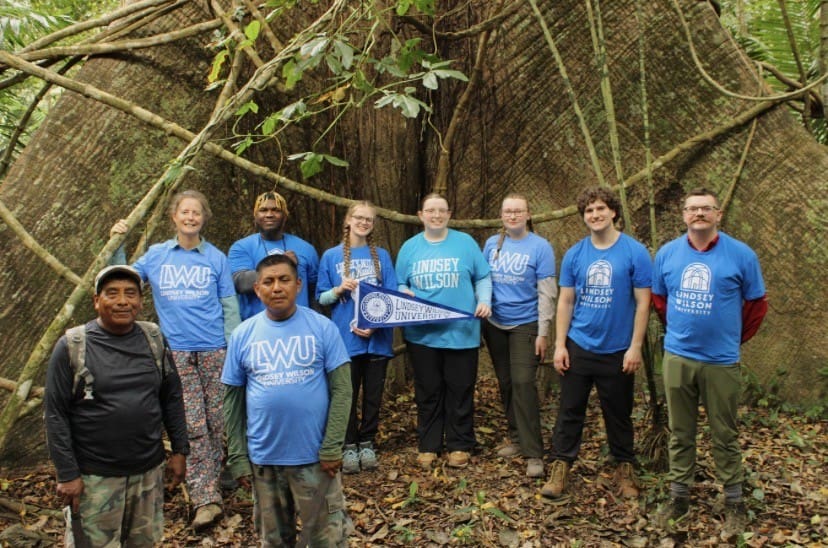
Lindsey Wilson University faculty and students are joined by their guides in front of the buttress roots of a Ceiba tree in a Belize rainforest. Pictured in front are guides Ranger Marcos Kuk, left, and Head Ranger Sipirano Canti; from LWU, from left: biology professor Sara Ash; Richard Newland ’26 of Franklin, Kentucky; Kaylee Butler ’27 of Columbia; Makayla Melson ’26 of Russell Springs, Kentucky; Heather Eggleston ’26 of Lebanon, Tennessee; Connor Wilhoit ’27 of Campbellsville, Kentucky; and instructor Evan Mahanna ’22, sustainability and environmental studies program coordinator.
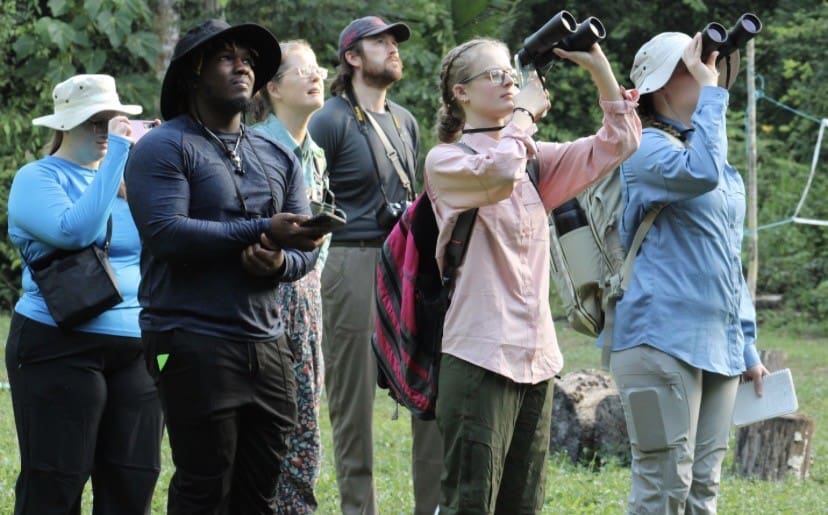
Lindsey Wilson University biology professor Sara Ash, third from left, leads LWU students in an early morning hike to spot scarlet macaw during a study-abroad trip in Belize. Pictured, from left: Makayla Melson ’26 of Russell Springs, Kentucky; Richard Newland ’26 of Franklin, Kentucky; Ash; Kaylee Butler ’27 of Columbia; and Heather Eggleston ’26 of Lebanon, Tennessee.
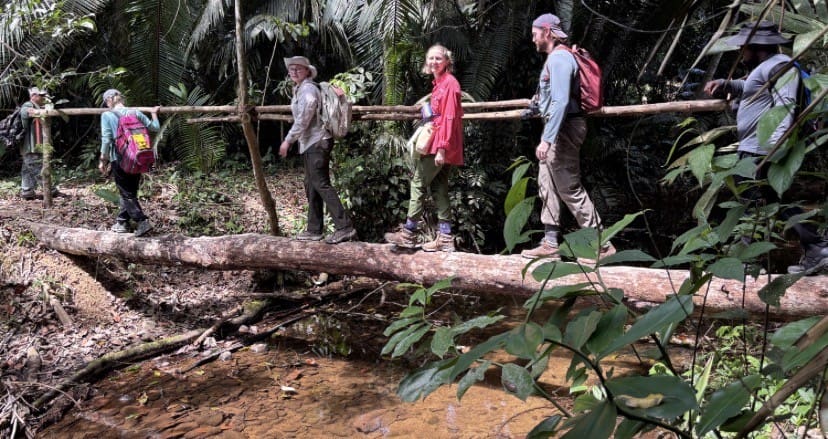
Lindsey Wilson University students cross a stream while hiking the northern boundary line of the BFREE property, led by the BFREE rangers during an LWU study-abroad trip to Belize.
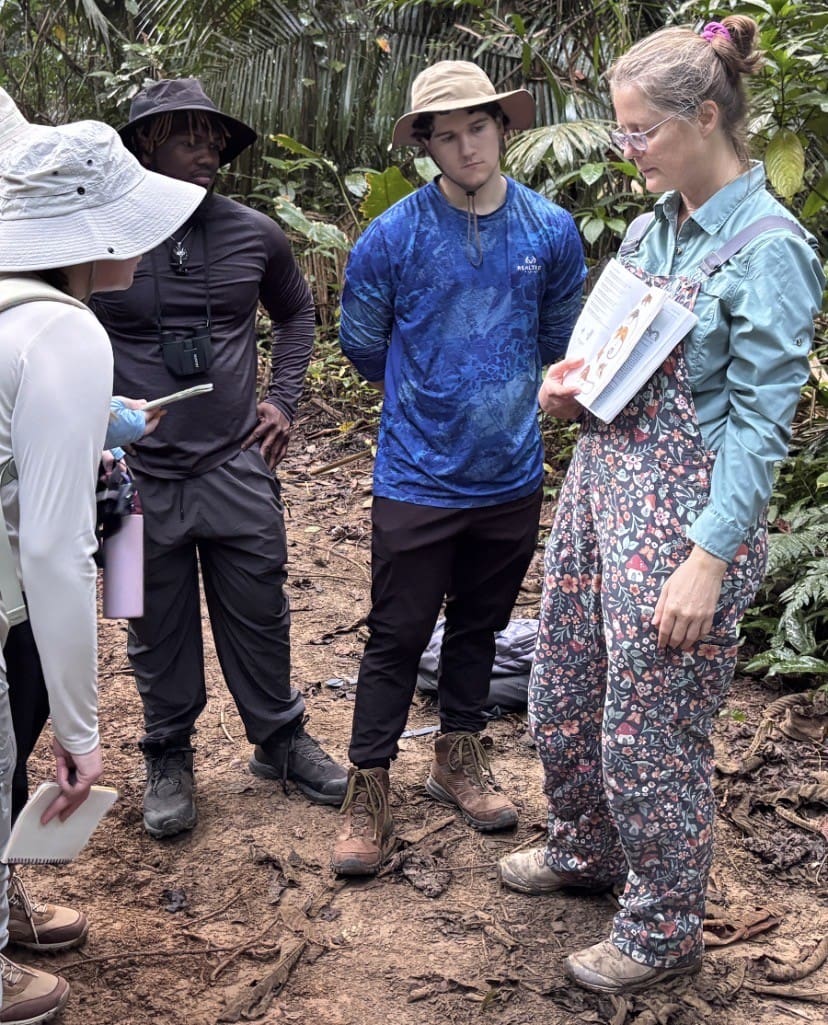
Lindsey Wilson University biology professor Sara Ash, right, gives a field lesson on identification and characteristics of the small mammals in Belize as students, from left, Heather Eggleston ’26 of Lebanon, Tennessee, Richard Newland ’26 of Franklin, Kentucky, and Connor Wilhoit ’27 of Campbellsville, Kentucky, look on.
Lindsey Wilson University is a vibrant liberal arts university in Columbia, Kentucky. Founded in 1903 and affiliated with The United Methodist Church, the mission of Lindsey Wilson is to serve the educational needs of students by providing a living-learning environment within an atmosphere of active caring and Christian concern where every student, every day, learns and grows and feels like a real human being. Lindsey Wilson offers 28 undergraduate majors, five graduate programs and a doctoral program. The university’s 29 intercollegiate varsity athletic teams have won more than 120 team and individual national championships.
(Duane Bonifer – Lindsey Wilson University)